
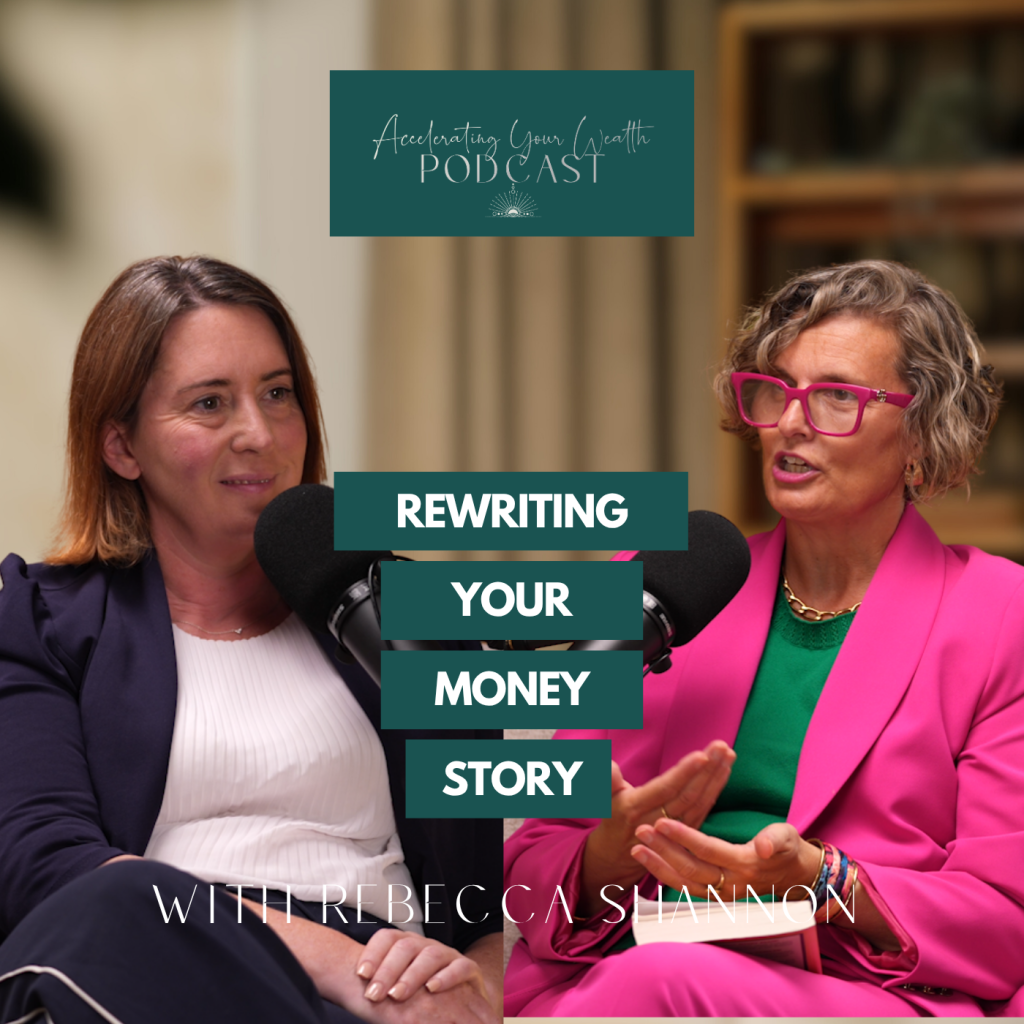
Ten years ago, Rebecca Shannon was going through a divorce, raising three young boys, and trying to hold onto the family home. Today she is a leadership coach, speaker and author known as much for her bright pink wardrobe as for the six-figure coaching business she has built. On a recent episode of the *Accelerating Your Wealth* podcast, host Rebecca Robertson sat down with her namesake to talk about how she got from one version of herself to the other and what that journey has taught her about money, grief and self-worth along the way.
Losing Her Colour, One Compromise at a Time
Shannon traces the unravelling back further than the divorce. She talks about flamingos: mother birds that fade in colour as they pour everything into raising their young. It’s the image she uses for what happened to her not all at once, but gradually, as she gave herself away to a marriage, to work that drained her, and to caring for a father with Alzheimer’s.
“It wasn’t really lost,” she says of that version of herself. “It was just being hidden underneath a lot of other things under grey clothes, black clothes, trying to fit in, trying to do the right thing, trying to people-please.”
By the time she hit bottom, she had nothing left to give and that, she says, is exactly when people started drifting away. It was the wake-up call that led her to a simple but uncomfortable idea: you have to fill your own cup before you can pour from it.
The Trouble with Telling Women to Set Boundaries
Robertson pushes back gently here, and it’s one of the more honest exchanges in the conversation. Telling a natural giver to say no, to put herself first, can land as cold or even selfish — especially for women who grew up with few role models for what financially confident, boundaried womanhood actually looks like.
Shannon agrees but reframes the goal. It was never about becoming hard or unavailable. It was about discernment, choosing where her energy went instead of handing it to anyone who asked. She’s blunt about the psychology underneath a lot of people-pleasing, too: often it’s less about the other person and more about the validation it brings the giver. Naming that, she says, is what actually makes it possible to change.
Surrendering the Fight
The divorce itself gets a candid retelling. Shannon describes resisting, at every turn, a solicitor who kept nudging her toward letting go rather than fighting. It took years before she took that advice, and when she finally did, the case settled roughly where it would have anyway, minus the expense and the toll on her sons.
Looking back, she wishes she’d surrendered sooner. It’s a theme that resurfaces throughout the conversation: the difference between forcing an outcome and trusting that things will land where they’re meant to, in their own time.
Learning to Talk About Money
The second half of the conversation turns to the subject that gives the podcast its name and the book that reshaped how Shannon works with clients. She describes discovering *How to Solve All Your Money Problems Forever* by Victor Boc, recommended to her years earlier by a mentor, and only picking it up properly once she noticed her own language around money hadn’t caught up with the “abundance” talk she’d been coaching around for years.
The method, as she explains it, comes down to two things: identifying what pulls money toward you (clarity, specific affirmations, daily practice) and what quietly repels it — old stories about money being difficult, or dangerous, or somehow at odds with being a good person. Most people are fluent in the first part and blind to the second, she says, which is why the book’s simple “cancel, cancel” technique for catching a limiting thought mid-flow has stuck with her clients.
It’s not about chasing overnight riches, she’s careful to say. It’s about changing your relationship with money enough that the problems stop recurring.
The Year She Stripped Everything Back
Not every part of the conversation is about scaling up. Shannon talks openly about a period, as menopause hit, when she deliberately scaled her business right back cancelled programmes, paused her podcast, simplified everything. Shortly after, her horse died, and she found herself grateful she’d already cleared the space to grieve.
She pushes back on the idea that this counts as failure. Choosing to strip back, she argues, takes just as much courage as building up, and women in particular tend to read rest as weakness rather than as its own kind of growth.
That season was followed by a health scare and a diagnosis of ulcerative colitis, the same condition her late mother lived with. Shannon talks about meeting it not as confirmation of her worst fears, but as something she was finally equipped to face with self-awareness rather than panic, largely because, she says, she’d already done the work of learning to love herself through hard things.
Grief, Undramatised
One of the more understated moments comes when the conversation turns to losing her mother last year, and her father to Alzheimer’s eight years before that. Shannon is matter of fact about it: their relationship was complicated, she didn’t need sympathy, and she found it more useful to talk about the loss openly than to let shame keep it private. Robertson, in turn, shares her own experience of losing a horse she’d waited decades to own a smaller loss by most measures, but one that opened up grief she hadn’t expected.
Both agree grief doesn’t get talked about enough, and that it isn’t reserved for the biggest losses it shows up whenever an identity, a routine or a relationship falls away.
Small Daily Habits, Not Grand Gestures
Asked for practical takeaways, Shannon keeps it simple: journaling, five minutes of unstructured quiet each day, noticing your breath, and asking one question regularly *what do I truly desire, right now? * None of it is dressed up as a big transformation. It’s the daily repetition, she says, that actually rewires decades of conditioning.
Rebecca Robertson in the Accelerating Your Wealth podcast.